Department of Government

Welcome to the Department of Government

On the Potomoc
rowers Georgetown's Department of Government is one of the leading programs in political science in the United States. Our faculty has expertise in all major regions of the world including the Americas, Europe, Asia, the Middle East, Africa, and the Antarctic. We also have a wide range of functional expertise and offer training in international relations (security studies, international political economy, U.S. foreign policy, and international law, institutions, and ethics), comparative politics (comparative methodology, development theory, democratic transitions, state building, and the political economy of development), political theory (classical and medieval philosophy, early modern political thought, continental political thought, federalism and early American political thought), and American government (the presidency, Congress, the judiciary, the bureaucracy, political parties, women and politics, and public opinion and political behavior).

Grad Students Faculty in the department have published articles in the leading journals, including World Politics, Foreign Affairs, International Organization, International Studies Quarterly, the Journal of PoliticsAmerican Political Science Review, the American Journal of Political Science and International Security, and books in the leading university presses, including Princeton, Chicago, Cambridge, Oxford, and M.I.T.  Current and recent graduate students have also published in top journals, including World Politics, the Review of Politics, and International Studies Quarterly, and have gone on to tenure track jobs at universities across the country and around the world.  The quality of the department is reflected by its rapid and continuing rise in its international reputation -- it rose twenty-three places in the most recent National Research Council rankings of graduate programs in political science.

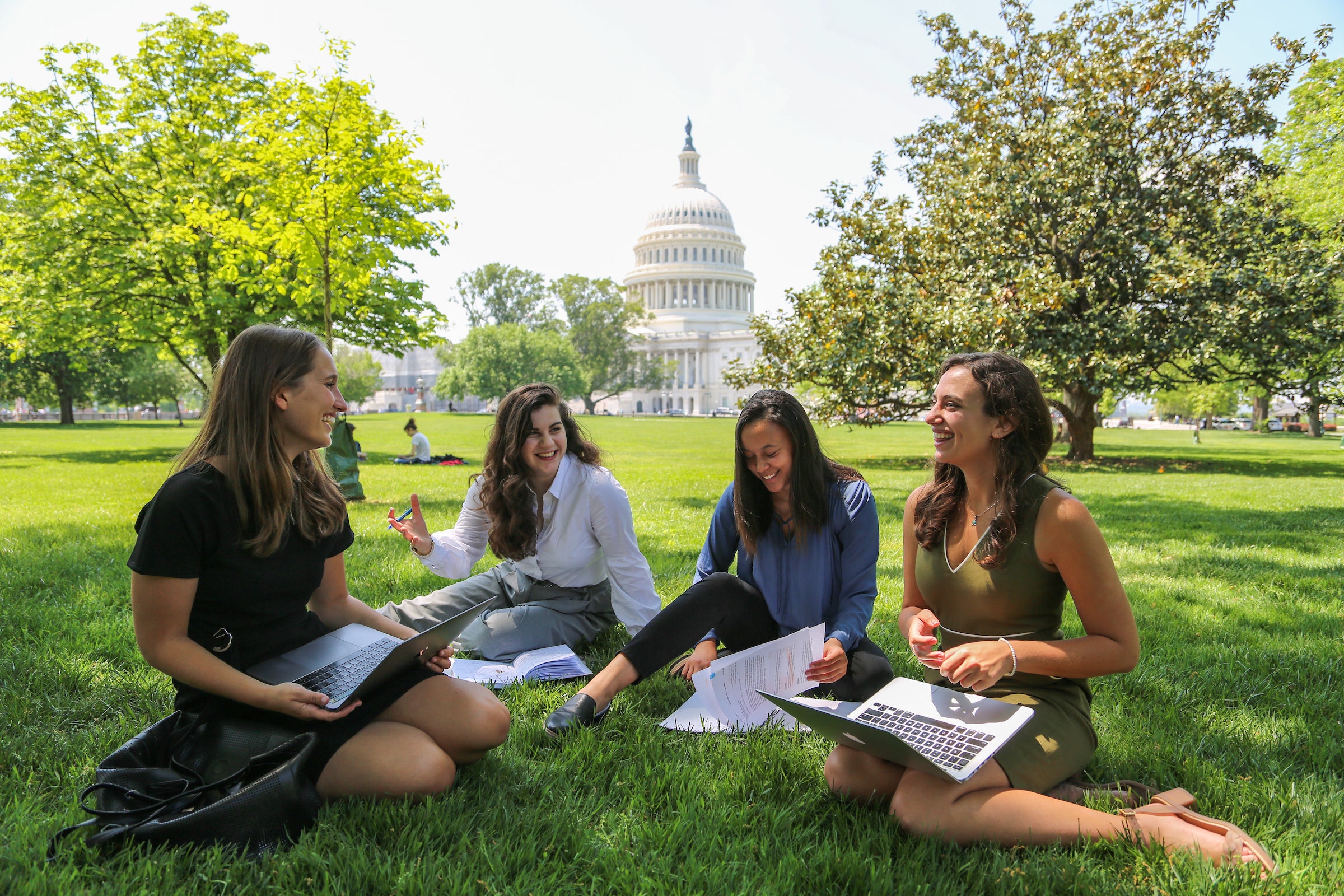
Riggs LibraryOur faculty has a longstanding reputation for theoretical and methodological pluralism. We use and teach a variety of theoretical perspectives as well as a range of qualitative, quantitative, formal models, and legal research methodologies. In addition to its strengths in a broad range of substantive and methodological areas, the Department has developed niches of particular excellence in which it has comparative advantages even relative to other top programs. Many of these - including our strengths in international relations, foreign policy and American political institutions - generate a nexus between theory and policy that capitalizes on Georgetown's location in Washington D.C. Washington is not only the seat of the U.S. Federal government, it is an international city with embassies from around the world, diverse ethnic communities, and wide ranging business, academic and policy-oriented institutions, all of which give undergraduate and graduate students diverse opportunities for internships and employment.

John CarrollIn addition, many of the faculty are jointly appointed with the Georgetown University School of Foreign Service (SFS), who have other prominent faculty in international relations, including former Secretary of State Madeleine Albright, former National Security Advisor Anthony Lake, several U.S. Ambassadors to the United Nations (Donald McHenry, in addition to Albright), and several top State Department officials and negotiators (Chester Crocker and Dean Robert Gallucci). A number of other SFS faculty (Michael E. Brown, Daniel Byman, Elizabeth Stanley-Mitchell) specialize in areas of the discipline that are important in international relations.


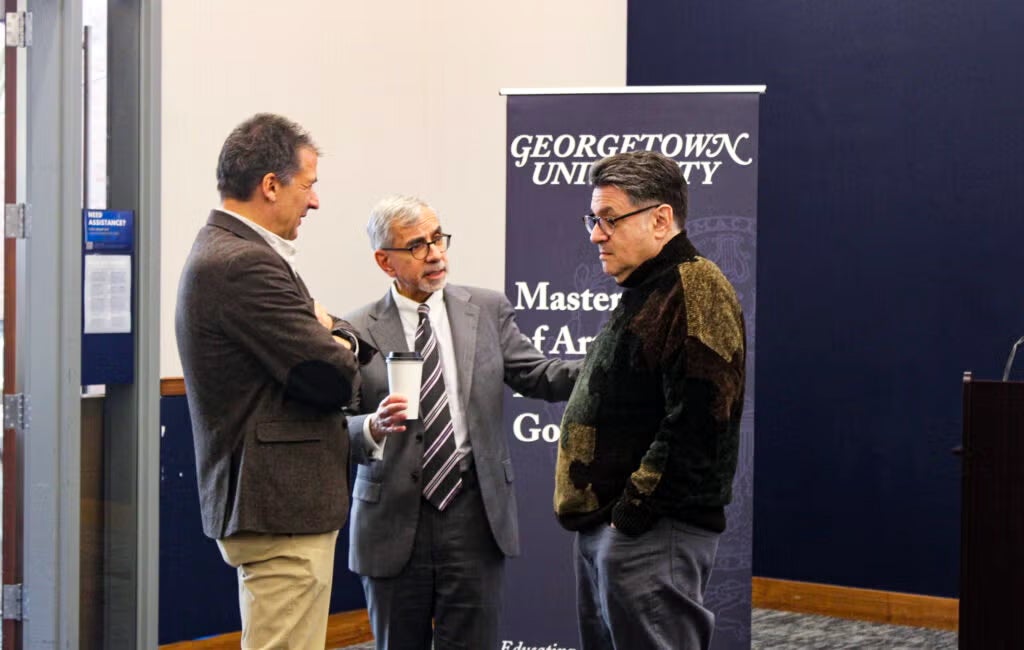
Arendt TeachingThe Department has a collegial, non-hierarchical atmosphere in which faculty are accessible to students. Department faculty share a conviction that cutting-edge research and excellent teaching are complementary, and in addition to publishing in the leading journals and university presses, Department faculty average 4.5 on a five point scale in teaching evaluations in undergraduate and graduate courses. The Department also encourages a vibrant intellectual atmosphere among students and between students and faculty. For undergraduates, faculty advise students on scholarship programs, graduate programs, and careers. On the graduate level, faculty encourage students to present papers at conferences, where our graduate students have won prizes for the best papers presented, and to submit papers for publication in journals.


Headlines

Upcoming Events